
Articles in English, Real estate & property law
Understanding Land Title Deeds in Thailand: A Practical Guide for Property Buyers
Mar
Anyone considering the purchase of land or property in Thailand must first understand the country’s land title system. Unlike many Western jurisdictions where ownership documentation tends to follow a single standardized model, Thailand recognizes several different forms of land documents. These documents grant varying levels of rights to the holder, and not all of them provide full ownership.
Because of these differences, reviewing the type of title deed attached to a property is a crucial step in any real estate transaction. In many cases, misunderstandings arise when buyers assume that all land documents provide the same legal protection, which is not necessarily the case.
What is a Title Deed in Thailand?
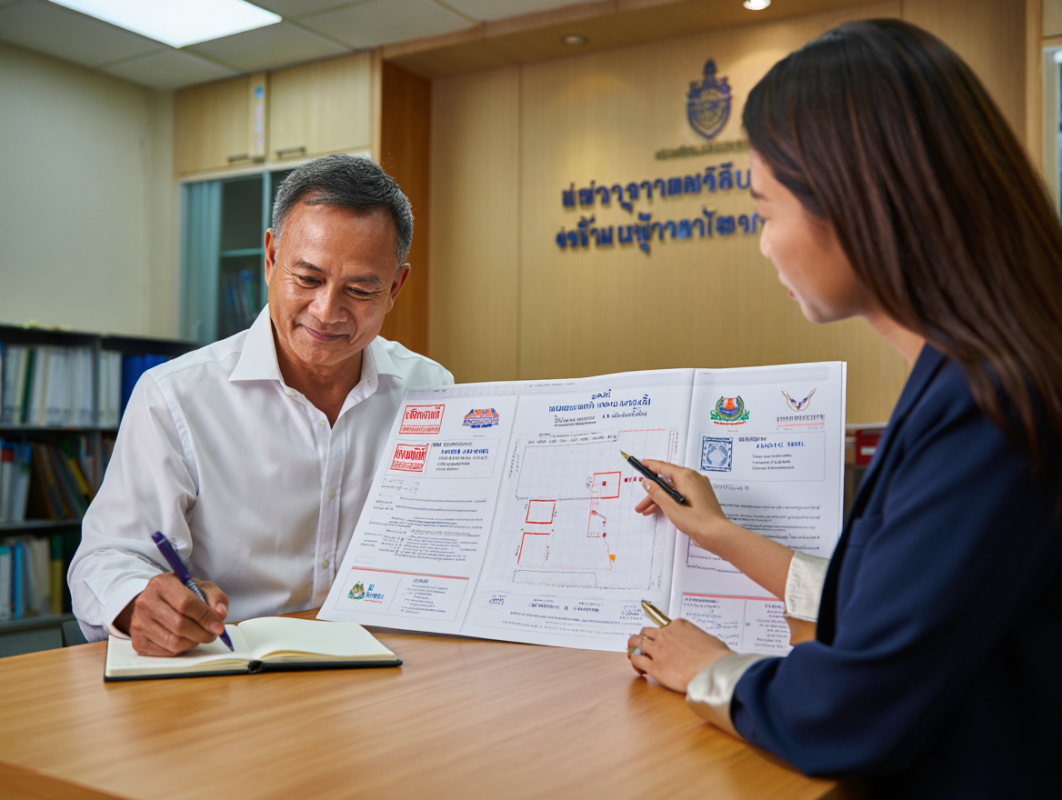
A title deed is the document that demonstrates a person’s legal rights over a specific parcel of land. It functions as evidence of ownership or possession rights, depending on the type of document involved.
The title deed identifies the land, describes its boundaries and confirms the legal rights attached to the property. Without a valid title document, it may be difficult to prove ownership or register certain rights over the land.
It is also important to distinguish between a title deed and a sale agreement. A sale agreement records the transaction between buyer and seller, while the title deed itself constitutes the official proof of ownership of the land.
All official property registrations and transfers are handled through the Thai Land Office, which serves as the land registry where property rights are formally recorded.
Why the type of Title Deed matters
Thailand recognizes several categories of land documents, each providing different levels of legal certainty. Some titles confirm full ownership, while others merely recognize a right to possess or occupy the land.
Understanding the nature of the title attached to a property is therefore essential before signing any purchase agreement. Some types of titles provide limited rights or impose restrictions on transfer, sale, or registration of additional rights.
For this reason, legal due diligence is strongly recommended before acquiring land in Thailand.
Common types of Land Title Deeds
Sor Kor Nung
Sor Kor Nung is an older form of land documentation. This document primarily records a person’s right to occupy farmland and does not provide full ownership rights.
The Land Department stopped issuing this document many years ago, and it is now rarely encountered in modern transactions. In addition, this type of document cannot be upgraded into a full title deed. As a result, it generally offers limited legal security for property buyers.
Another important limitation is that certain rights—such as usufructs or other registered interests—cannot be recorded against this type of land document.
Nor Sor Song
The Nor Sor Song document is essentially a letter of consent allowing the holder to temporarily occupy land. It does not grant ownership rights and cannot be freely transferred.
Land under this document generally cannot be sold or transferred except by inheritance. Although the document may sometimes be upgraded to higher forms of land titles, the limitations on transfer remain significant.
Because of these restrictions, Nor Sor Song documents are typically unsuitable for property purchases intended as long-term investments.
Nor Sor Saam
Nor Sor Saam represents a certificate confirming a person’s right to use or possess a particular parcel of land. However, the boundaries of the land have not yet been precisely surveyed or formally marked by the Land Department.
This means that the exact limits of the property may still require confirmation in relation to neighboring plots.
Although land with this title may be sold, the process involves additional formalities. A public notice period of approximately 30 days is generally required before a transaction can proceed. This allows neighboring landowners to raise objections if boundary disputes arise.
Nor Sor Saam Gor
Nor Sor Saam Gor is an upgraded form of Nor Sor Saam. In this case, the land has been surveyed more precisely and the parcel boundaries have been determined through aerial mapping.
As a result, transactions involving this type of land are usually simpler. The requirement for a public notice period prior to sale is generally not necessary.
While this title provides a higher level of certainty than Nor Sor Saam, it is still considered inferior to the highest form of title deed in Thailand.
Nor Sor Saam Khor
Nor Sor Saam Khor is another variation derived from Nor Sor Saam Gor. In this case, the boundaries have been established by officials from the Land Department rather than through aerial surveying.
Although this document represents a further step in the land title hierarchy, it still does not provide the same legal certainty as a full ownership title.
Chanote (Nor Sor Si Jor)
The Chanote title deed—also known as Nor Sor Si Jor—is widely regarded as the most secure form of land title in Thailand.
This document confirms full ownership of the land and is issued following a precise cadastral survey. Each plot is mapped and linked to a national survey grid, and boundary markers are physically placed on the land.
Because of its accuracy and legal certainty, Chanote land can generally be transferred, mortgaged, subdivided, or otherwise registered without the additional restrictions found in other title types.
For property buyers, particularly foreign investors, the Chanote title is generally considered the safest form of land documentation.
Restrictions and special considerations
Even with a Chanote title, certain restrictions may still exist. In some cases, land issued under government land reform programs may carry conditions that limit resale or transfer for a specified period.
Another issue sometimes encountered concerns discrepancies between the size recorded on the title deed and the actual land area on the ground. For example, a title may indicate a larger plot than what is physically present.
This is one reason why professional verification of the title deed and property boundaries is strongly recommended prior to completing any purchase.
Encumbrances and rights over land
A title deed may also contain registered encumbrances or rights held by third parties. These may include mortgages, leases, or other legal interests recorded against the property.
Buyers should therefore review the title carefully to confirm whether such rights exist and whether they may affect the intended use of the property.
Possession issues and long-term occupation
Another factor to consider involves long-term occupation by third parties. In certain circumstances, if a person has occupied land continuously for a long period without objection from the registered owner, they may attempt to claim rights over the land.
For this reason, confirming the actual possession and use of the property is an important element of due diligence.
Why Legal review is essential before buying land
Property law in Thailand involves a number of administrative and legal complexities. The existence of multiple types of title deeds, each granting different levels of rights, makes it essential to verify the legal status of any land before completing a transaction.
A proper legal review typically involves examining the title deed, confirming ownership with the Land Office, and identifying any restrictions or encumbrances attached to the property.
Taking these steps helps reduce the risk of disputes or misunderstandings after the purchase.
Conclusion
Thailand’s land title system differs significantly from systems commonly used in Western countries. Several types of land documents exist, and not all of them provide full ownership rights.
Among the various forms of land titles, the Chanote deed generally offers the highest level of legal certainty. Other documents—such as Nor Sor Saam or Nor Sor Saam Gor—may still be valid but provide different degrees of security and may require additional verification.
For anyone considering purchasing property in Thailand, understanding the nature of the title deed attached to the land is a fundamental step. A careful review of the title and the rights associated with it remains one of the most effective ways to ensure that the transaction proceeds safely and in accordance with Thai law.
